What Type of Art Inspired Him to Use Pure Abstraction

Robert Delaunay, 1912–13, Le Premier Disque, 134 cm (52.vii in.), individual drove
Abstract art uses visual language of shape, grade, color and line to create a composition which may exist with a caste of independence from visual references in the world.[one] Western art had been, from the Renaissance upwardly to the center of the 19th century, underpinned by the logic of perspective and an try to reproduce an illusion of visible reality. By the end of the 19th century many artists felt a need to create a new kind of art which would encompass the central changes taking identify in technology, scientific discipline and philosophy. The sources from which individual artists drew their theoretical arguments were diverse, and reflected the social and intellectual preoccupations in all areas of Western civilization at that time.[2]
Abstract art, non-figurative fine art, non-objective fine art, and not-representational art, are closely related terms. They are like, but perhaps non of identical meaning.
Abstraction indicates a divergence from reality in depiction of imagery in fine art. This departure from authentic representation can be slight, partial, or consummate. Abstraction exists along a continuum. Even art that aims for verisimilitude of the highest degree tin be said to be abstract, at least theoretically, since perfect representation is incommunicable. Artwork which takes liberties, altering for case color and form in ways that are conspicuous, can be said to exist partially abstract. Full abstraction bears no trace of any reference to anything recognizable. In geometric abstraction, for instance, one is unlikely to find references to naturalistic entities. Figurative art and total abstraction are almost mutually sectional. Simply figurative and representational (or realistic) art oft contain fractional abstraction.
Both geometric brainchild and lyrical abstraction are often totally abstract. Amidst the very numerous art movements that embody partial brainchild would exist for example fauvism in which color is conspicuously and deliberately contradistinct vis-a-vis reality, and cubism, which alters the forms of the existent life entities depicted.[3] [four]
Brainchild in early art and many cultures [edit]
Much of the art of earlier cultures – signs and marks on pottery, textiles, and inscriptions and paintings on stone – used elementary, geometric and linear forms which might have had a symbolic or decorative purpose.[5] It is at this level of visual meaning that abstruse art communicates.[6] 1 tin can enjoy the beauty of Chinese calligraphy or Islamic calligraphy without being able to read it.[7]
Islamic world [edit]

A hilya, a decorated description of Muhammad'due south physical appearance, dating to the 19th century.
Islam's sometimes negative view of figurative art has led to the proliferation of complex non-figurative artistic expression across the Islamic world. Non-figurative Islamic art is most as old every bit Islam itself, and some of the oldest examples of it can be establish on such early buildings as the Dome of the Rock. While Islamic fine art may have reservations near painting humans and animals, it does not, however, feel the same nigh plants and inanimate objects.
Islamic art traditionally revolves effectually calligraphy, tessellating geometric patterns, and vegetal motifs called arabesques. These elements tin can be plant in all Islamic applied arts, including architecture, rugmaking, pottery, glassmaking, and metalwork, besides as decorating the borders of otherwise figurative paintings.
As a result of the extensive dialogue between the Christian and Islamic world brought most past the Crusades, Islamic patterns and techniques would also come to be applied to European decorative arts, particularly in Italy and Espana. Prominent examples include Spanish Mudéjar art and Venetian Gothic compages.
East asia [edit]

Immortal in splashed ink, Liang Kai, People's republic of china, 12th century
In Chinese painting, brainchild can be traced to the Tang dynasty painter Wang Mo (王墨), who is credited to have invented the splashed-ink painting fashion.[8] While none of his paintings remain, this style is clearly seen in some Song Dynasty Paintings. The Chan buddhist painter Liang Kai (梁楷, c. 1140–1210) applied the style to figure painting in his "Immortal in splashed ink" in which authentic representation is sacrificed to enhance spontaneity linked to the non-rational mind of the enlightened. A late Song painter named Yu Jian, adept to Tiantai buddhism, created a series of splashed ink landscapes that eventually inspired many Japanese Zen painters. His paintings show heavily misty mountains in which the shapes of the objects are barely visible and extremely simplified. This type of painting was continued by Sesshu Toyo in his subsequently years.

Mountain market, clearing Mist, Yu Jian, China
Another instance of abstraction in Chinese painting is seen in Zhu Derun'due south Cosmic Circumvolve. On the left side of this painting is a pine tree in rocky soil, its branches laced with vines that extend in a hell-raising mode to the right side of the painting in which a perfect circumvolve (probably fabricated with assist of a compass[nine]) floats in the void. The painting is a reflection of the Daoist metaphysics in which chaos and reality are complementary stages of the regular course of nature.
In Tokugawa Japan, some Zen monk-painters created Enso, a circle who represents the absolute enlightenment. Usually made in ane spontaneous brush stroke, it became the prototype of the minimalist aesthetic that guided role of the Zen painting.
19th century [edit]
Patronage from the church building diminished and private patronage from the public became more capable of providing a livelihood for artists.[10] [11] Three art movements which contributed to the development of abstruse fine art were Romanticism, Impressionism and Expressionism. Artistic independence for artists was advanced during the 19th century. An objective interest in what is seen, tin can be discerned from the paintings of John Constable, J M W Turner, Camille Corot and from them to the Impressionists who connected the plein air painting of the Barbizon school.
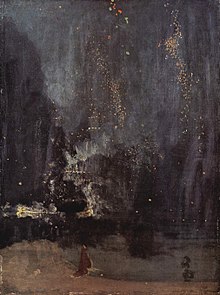
Early on intimations of a new fine art had been made past James McNeill Whistler who, in his painting Nocturne in Black and Aureate: The falling Rocket, (1872), placed greater emphasis on visual sensation than the delineation of objects. Fifty-fifty earlier than that, with her 'spirit' drawings, Georgiana Houghton's option to work with abstract shapes correlate with the unnatural nature of her subject, in a time when abstraction" isn't withal a concept (she organized an exhibit in 1871).
Expressionist painters explored the bold use of pigment surface, drawing distortions and exaggerations, and intense color. Expressionists produced emotionally charged paintings that were reactions to and perceptions of gimmicky feel; and reactions to Impressionism and other more bourgeois directions of belatedly 19th-century painting. The Expressionists drastically changed the emphasis on field of study matter in favor of the portrayal of psychological states of beingness. Although artists like Edvard Munch and James Ensor drew influences principally from the work of the Post-Impressionists they were instrumental to the advent of abstraction in the 20th century. Paul Cézanne had begun equally an Impressionist but his aim – to make a logical construction of reality based on a view from a single point,[14] with modulated color in flat areas – became the ground of a new visual fine art, after to exist adult into Cubism by Georges Braque and Pablo Picasso.
Additionally in the late 19th century in Eastern Europe mysticism and early modernist religious philosophy as expressed by theosophist Mme. Blavatsky had a profound impact on pioneer geometric artists like Hilma af Klint and Wassily Kandinsky. The mystical teaching of Georges Gurdjieff and P.D. Ouspensky also had an important influence on the early on formations of the geometric abstract styles of Piet Mondrian and his colleagues in the early 20th century.[15] The spiritualism too inspired the abstract art of Kasimir Malevich and František Kupka.[16]
20th century [edit]

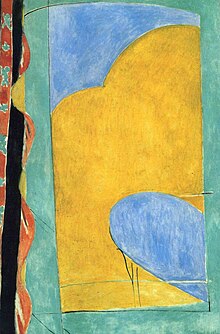
Post-Impressionism as skillful past Paul Gauguin, Georges Seurat, Vincent van Gogh and Paul Cézanne had an enormous impact on 20th-century art and led to the appearance of 20th-century abstraction. The heritage of painters similar Van Gogh, Cézanne, Gauguin, and Seurat was essential for the development of modern art. At the showtime of the 20th century Henri Matisse and several other young artists including the pre-cubist Georges Braque, André Derain, Raoul Dufy and Maurice de Vlaminck revolutionized the Paris art earth with "wild", multi-colored, expressive landscapes and figure paintings that the critics called Fauvism. With his expressive employ of color and his complimentary and imaginative drawing Henri Matisse comes very close to pure abstraction in French Window at Collioure (1914), View of Notre-Dame (1914), and The Xanthous Curtain from 1915. The raw linguistic communication of color as adult by the Fauves straight influenced another pioneer of brainchild, Wassily Kandinsky.
Although Cubism ultimately depends upon discipline affair, information technology became, along with Fauvism, the fine art motion that direct opened the door to abstraction in the 20th century. Pablo Picasso made his first cubist paintings based on Cézanne'due south idea that all depiction of nature can be reduced to 3 solids: cube, sphere and cone. With the painting Les Demoiselles d'Avignon (1907), Picasso dramatically created a new and radical film depicting a raw and primitive brothel scene with five prostitutes, violently painted women, reminiscent of African tribal masks and his ain new Cubist inventions. Analytic cubism was jointly developed by Pablo Picasso and Georges Braque, from about 1908 through 1912. Analytic cubism, the kickoff clear manifestation of cubism, was followed by Synthetic cubism, practiced by Braque, Picasso, Fernand Léger, Juan Gris, Albert Gleizes, Marcel Duchamp and others into the 1920s. Synthetic cubism is characterized by the introduction of dissimilar textures, surfaces, collage elements, papier collé and a big variety of merged bailiwick affair. The collage artists like Kurt Schwitters and Man Ray and others taking the clue from Cubism were instrumental to the development of the movement called Dada.
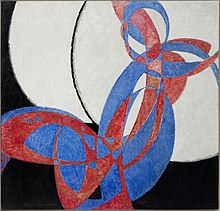
František Kupka, Amorpha, Fugue en deux couleurs (Fugue in Two Colors), 1912, oil on sheet, 210 x 200 cm, Narodni Galerie, Prague. Published in Au Salon d'Automne "Les Indépendants" 1912, Exhibited at the 1912 Salon d'Automne, Paris.

Robert Delaunay, 1912, Windows Open Simultaneously (Kickoff Part, Third Motif), oil on canvas, 45.vii × 37.5 cm, Tate Modernistic
The Italian poet Filippo Tommaso Marinetti published the Manifesto of Futurism in 1909, which afterward inspired artists such as Carlo Carra in Painting of Sounds, Noises and Smells and Umberto Boccioni Train in Motion, 1911, to a further phase of abstraction that would, along with Cubism, profoundly influenced fine art movements throughout Europe.[17]
During the 1912 Salon de la Section d'Or, where František Kupka exhibited the abstruse painting Amorpha, Fugue en deux couleurs (Fugue in 2 Colors) (1912), the poet Guillaume Apollinaire named the work of several artists including Robert Delaunay, Orphism.[18] He defined it as, "the art of painting new structures out of elements that have non been borrowed from the visual sphere, just had been created entirely by the creative person...it is a pure fine art."[19]
Since the plough of the century, cultural connections between artists of the major European cities had become extremely active as they strove to create an art form equal to the loftier aspirations of modernism. Ideas were able to cantankerous-fertilize by means of artist's books, exhibitions and manifestos so that many sources were open to experimentation and discussion, and formed a basis for a variety of modes of brainchild. The following extract from The World Backwards gives some impression of the inter-connection of culture at the time: "David Burliuk's knowledge of modern fine art movements must have been extremely up-to-date, for the second Knave of Diamonds exhibition, held in Jan 1912 (in Moscow) included not merely paintings sent from Munich, only some members of the German Die Brücke group, while from Paris came piece of work by Robert Delaunay, Henri Matisse and Fernand Léger, as well equally Picasso. During the Leap David Burliuk gave two lectures on cubism and planned a polemical publication, which the Knave of Diamonds was to finance. He went abroad in May and came back determined to rival the almanac Der Blaue Reiter which had emerged from the printers while he was in Germany".[20]
From 1909 to 1913 many experimental works in the search for this 'pure art' had been created by a number of artists: Francis Picabia painted Caoutchouc, c. 1909,[21] The Spring, 1912,[22] Dances at the Jump [23] and The Procession, Seville, 1912;[24] Wassily Kandinsky painted Untitled (Showtime Abstract Watercolor), 1913,[25] Improvisation 21A, the Impression series, and Picture with a Circle (1911);[26] František Kupka had painted the Orphist works, Discs of Newton (Study for Fugue in Two Colors), 1912[27] and Amorpha, Fugue en deux couleurs (Fugue in Two Colors), 1912; Robert Delaunay painted a series entitled Simultaneous Windows and Formes Circulaires, Soleil north°two (1912–13);[28] Léopold Survage created Colored Rhythm (Written report for the movie), 1913;[29] Piet Mondrian, painted Tableau No. 1 and Limerick No. xi, 1913.[30]

Wassily Kandinsky, untitled (report for Composition VII, Première abstraction), watercolor, 1913[31]

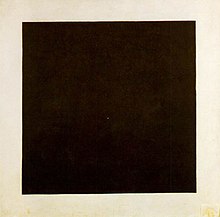
And the search connected: The Rayist (Luchizm) drawings of Natalia Goncharova and Mikhail Larionov, used lines like rays of low-cal to make a structure. Kasimir Malevich completed his commencement entirely abstract work, the Suprematist, Black Square, in 1915. Some other of the Suprematist group' Liubov Popova, created the Architectonic Constructions and Spatial Strength Constructions between 1916 and 1921. Piet Mondrian was evolving his abstract language, of horizontal and vertical lines with rectangles of colour, between 1915 and 1919, Neo-Plasticism was the aesthetic which Mondrian, Theo van Doesburg and other in the group De Stijl intended to reshape the environment of the future.
Music [edit]
Every bit visual art becomes more than abstract, information technology develops some characteristics of music[ citation needed ]: an art form which uses the abstract elements of sound and divisions of time. Wassily Kandinsky, himself an apprentice musician,[32] [33] [34] was inspired past the possibility of marks and associative color resounding in the soul. The idea had been put frontward past Charles Baudelaire, that all our senses reply to various stimuli but the senses are connected at a deeper aesthetic level.
Closely related to this, is the idea that fine art has The spiritual dimension and can transcend 'every-solar day' feel, reaching a spiritual plane. The Theosophical Society popularized the aboriginal wisdom of the sacred books of Republic of india and Red china in the early on years of the century. Information technology was in this context that Piet Mondrian, Wassily Kandinsky, Hilma af Klint and other artists working towards an 'objectless state' became interested in the occult as a way of creating an 'inner' object. The universal and timeless shapes found in geometry: the circle, foursquare and triangle become the spatial elements in abstract art; they are, similar color, cardinal systems underlying visible reality.
Russian avant-garde [edit]
Many of the abstruse artists in Russian federation became Constructivists believing that art was no longer something remote, just life itself. The artist must get a technician, learning to utilise the tools and materials of modern production. Art into life! was Vladimir Tatlin's slogan, and that of all the future Constructivists. Varvara Stepanova and Alexandre Exter and others abandoned easel painting and diverted their energies to theatre design and graphic works. On the other side stood Kazimir Malevich, Anton Pevsner and Naum Gabo. They argued that art was essentially a spiritual activity; to create the individual's place in the globe, not to organize life in a applied, materialistic sense. Many of those who were hostile to the materialist production idea of art left Russian federation. Anton Pevsner went to France, Gabo went first to Berlin, so to England and finally to America. Kandinsky studied in Moscow so left for the Bauhaus. Past the mid-1920s the revolutionary menstruation (1917 to 1921) when artists had been gratuitous to experiment was over; and by the 1930s only socialist realism was allowed.[35]
The Bauhaus [edit]
The Bauhaus at Weimar, Germany was founded in 1919 by Walter Gropius.[36] The philosophy underlying the instruction program was unity of all the visual and plastic arts from architecture and painting to weaving and stained glass. This philosophy had grown from the ideas of the Craft movement in England and the Deutscher Werkbund. Amid the teachers were Paul Klee, Wassily Kandinsky, Johannes Itten, Josef Albers, Anni Albers, and László Moholy-Nagy. In 1925 the school was moved to Dessau and, every bit the Nazi party gained control in 1932, The Bauhaus was closed. In 1937 an exhibition of degenerate fine art, 'Entartete Kunst' contained all types of advanced art disapproved of by the Nazi political party. And so the exodus began: not merely from the Bauhaus but from Europe in general; to Paris, London and America. Paul Klee went to Switzerland just many of the artists at the Bauhaus went to America.
Abstraction in Paris and London [edit]
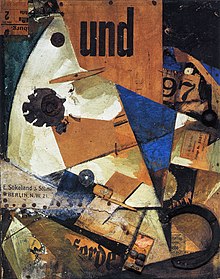
During the 1930s Paris became the host to artists from Russia, Germany, the Netherlands and other European countries afflicted by the rise of totalitarianism. Sophie Tauber and Jean Arp collaborated on paintings and sculpture using organic/geometric forms. The Smooth Katarzyna Kobro applied mathematically based ideas to sculpture. The many types of brainchild now in close proximity led to attempts by artists to analyse the diverse conceptual and artful groupings. An exhibition by forty-6 members of the Cercle et Carré group organized by Joaquín Torres-García[37] assisted by Michel Seuphor[38] contained work by the Neo-Plasticists every bit well as abstractionists every bit varied equally Kandinsky, Anton Pevsner and Kurt Schwitters. Criticized by Theo van Doesburg to be besides indefinite a collection he published the journal Art Concret setting out a manifesto defining an abstract art in which the line, color and surface but, are the concrete reality.[39] Abstraction-Création founded in 1931 as a more open group, provided a point of reference for abstract artists, every bit the political situation worsened in 1935, and artists again regrouped, many in London. The first exhibition of British abstract fine art was held in England in 1935. The following year the more international Abstract and Concrete exhibition was organized by Nicolete Greyness including work past Piet Mondrian, Joan Miró, Barbara Hepworth and Ben Nicholson. Hepworth, Nicholson and Gabo moved to the St. Ives grouping in Cornwall to continue their 'constructivist' work.[twoscore]
America: mid-century [edit]

A 1939–1942 oil on sheet painting past Piet Mondrian titled Composition No. 10. Responding to information technology, fellow De Stijl artist Theo van Doesburg suggested a link betwixt not-representational works of art and ethics of peace and spirituality.[41]
During the Nazi rising to power in the 1930s many artists fled Europe to the United States. By the early 1940s the main movements in modern art, expressionism, cubism, abstraction, surrealism, and dada were represented in New York: Marcel Duchamp, Fernand Léger, Piet Mondrian, Jacques Lipchitz, André Masson, Max Ernst, André Breton, were only a few of the exiled Europeans who arrived in New York.[42] The rich cultural influences brought by the European artists were distilled and built upon by local New York painters. The climate of freedom in New York allowed all of these influences to flourish. The fine art galleries that primarily had focused on European fine art began to find the local art community and the work of younger American artists who had begun to mature. Certain artists at this time became distinctly abstruse in their mature piece of work. During this catamenia Piet Mondrian's painting Composition No. 10, 1939–1942, characterized by primary colors, white ground and black grid lines conspicuously defined his radical but classical approach to the rectangle and abstract art in general. Some artists of the period defied categorization, such as Georgia O'Keeffe who, while a modernist abstractionist, was a pure maverick in that she painted highly abstract forms while not joining any specific group of the period.
Somewhen American artists who were working in a great diversity of styles began to coagulate into cohesive stylistic groups. The best-known group of American artists became known every bit the Abstruse expressionists and the New York Schoolhouse. In New York City in that location was an atmosphere which encouraged word and there was a new opportunity for learning and growing. Artists and teachers John D. Graham and Hans Hofmann became important span figures between the newly arrived European Modernists and the younger American artists coming of age. Mark Rothko, born in Russia, began with strongly surrealist imagery which subsequently dissolved into his powerful color compositions of the early on 1950s. The expressionistic gesture and the act of painting itself, became of primary importance to Jackson Pollock, Robert Motherwell, and Franz Kline. While during the 1940s Arshile Gorky's and Willem de Kooning's figurative work evolved into abstraction past the end of the decade. New York Metropolis became the heart, and artists worldwide gravitated towards it; from other places in America equally well.[43]
Later developments [edit]
Digital art, difficult-edge painting, geometric brainchild, minimalism, lyrical abstraction, op fine art, abstract expressionism, color field painting, monochrome painting, assemblage, neo-Dada, shaped canvass painting, are a few directions relating to abstraction in the 2d half of the 20th century.
In the U.s.a., Fine art equally Object as seen in the Minimalist sculpture of Donald Judd and the paintings of Frank Stella are seen today as newer permutations. Other examples include Lyrical Abstraction and the sensuous use of colour seen in the piece of work of painters as diverse every bit Robert Motherwell, Patrick Heron, Kenneth Noland, Sam Francis, Cy Twombly, Richard Diebenkorn, Helen Frankenthaler, Joan Mitchell.
Causation [edit]
One socio-historical explanation that has been offered for the growing prevalence of the abstract in mod fine art – an explanation linked to the name of Theodor W. Adorno – is that such abstraction is a response to, and a reflection of, the growing abstraction of social relations in industrial society.[44]
Frederic Jameson similarly sees modernist abstraction equally a function of the abstract ability of money, equating all things as as exchange-values.[45] The social content of abstract art is then precisely the abstract nature of social existence – legal formalities, bureaucratic impersonalization, information/power – in the globe of late modernity.[46]
Post-Jungians by dissimilarity would come across the breakthrough theories with their disintegration of conventional ideas of form and matter every bit underlying the divorce of the physical and the abstruse in modern art.[47]
Gallery [edit]
-
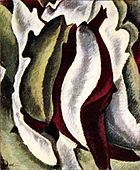
Arthur Pigeon, 1911–12, Based on Leaf Forms and Spaces, pastel on unidentified support. At present lost
-
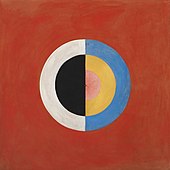
Hilma af Klint, Svanen (The Swan), No. 17, Grouping IX, Serial SUW, October 1914–March 1915. This abstract work was never exhibited during af Klint's lifetime.
-

Albert Gleizes, 1921, Composition bleu et jaune (Composition jaune), oil on canvas, 200.5 × 110 cm
-
See also [edit]
- Abstract fine art and Theosophy
- Abstract expressionism
- Abstraction in art
- Action painting
- American Abstract Artists
- Art history
- Art periods
- Asemic writing
- Colour field
- Concrete art
- De Stijl
- Geometric abstraction
- Hard-border
- History of painting
- Lyrical abstraction
- Op Art
- Representation (arts)
- Spatialism
- Surrealism
- Western painting
- In other media
- Abstract blitheness
- Abstract comics
- Abstract photography
- Experimental film
- Literary nonsense
- Musique concréte
- Noise music
References [edit]
- ^ Rudolph Arnheim, Visual Thinking, University of California Printing, 1969, ISBN 0-520-01871-0
- ^ Mel Gooding, Abstract Art, Tate Publishing, London, 2000
- ^ "Abstract Art – What Is Abstruse Fine art or Abstract Painting, retrieved January 7, 2009". Painting.near.com. 2011-06-07. Archived from the original on vii July 2011. Retrieved 2011-06-eleven .
- ^ "Themes in American Art – Brainchild, retrieved January 7, 2009". Nga.gov. 2000-07-27. Archived from the original on eight June 2011. Retrieved 2011-06-11 .
- ^ György Kepes, Sign, Image and Symbol, Studio Vista, London, 1966
- ^ Derek Hyatt,"Meeting on the Moor", Modern Painters, Autumn 1995
- ^ Simon Leys, 2013. The Hall of Uselessness: Collected Essays. New York: New York Review Books. p. 304. ISBN 978-1-59017-620-seven.
- ^ Lippit, Y. (2012). "Of Modes and Manners in Japanese Ink Painting: Sesshū's Splashed Ink Landscape of 1495". The Art Message, 94(1), p. 56.
- ^ Watt, J. C. (2010). The World of Khubilai Khan: Chinese Art in the Yuan Dynasty. Metropolitan Museum of Art, p. 224
- ^ Ernst Gombrich, "The Early Medici as Patrons of Fine art" in Norm and Form, pp. 35–57, London, 1966
- ^ Judith Balfe, ed. Paying the Piper: Causes and Consequences of Fine art Patronage, Univ. of Illinois Press
- ^ Whistler versus Ruskin, Princeton edu. Archived June sixteen, 2010, at the Wayback Automobile Retrieved June 13, 2010
- ^ From the Tate Archived 2012-01-12 at the Wayback Machine, retrieved April 12, 2009
- ^ Herbert Read, A Concise History of Modernistic Art, Thames and Hudson
- ^ "Hilton Kramer, "Mondrian & mysticism: My long search is over", New Criterion, September 1995". Newcriterion.com. Retrieved 2012-02-26 .
- ^ Brenson, Michael (December 21, 1986). "Art View; How the Spiritual Infused the Abstract". The New York Times.
- ^ Caroline Tisdall and Angelo Bozzolla, Futurism, Thames and Hudson, 1977
- ^ La Section d'or, 1912–1920–1925, Cécile Debray, Françoise Lucbert, Musées de Châteauroux, Musée Fabre, exhibition catalogue, Éditions Cercle d'art, Paris, 2000
- ^ Harrison and Woods, Art in theory, 1900–2000, Wiley-Blackwell, 2003, p. 189. ISBN 978-0-631-22708-3.books.google.com"
- ^ Susan P Compton, The Globe Backwards, British museum Publications, London, 1978
- ^ "Francis Picabia, Caoutchouc, c. 1909, MNAM, Paris". Francispicabia.org. Retrieved 2013-09-29 .
- ^ "Museum of Modern Art, New York, Francis Picabia, The Jump, 1912". Moma.org. Retrieved 2013-09-29 .
- ^ "MoMA, New York, Francis Picabia, Dances at the Spring, 1912". Moma.org. Retrieved 2013-09-29 .
- ^ "National Gallery of Art, Washington, DC., Francis Picabia, The Procession, Seville, 1912". Nga.gov. Archived from the original on 2012-08-05. Retrieved 2013-09-29 .
- ^ Stan Rummel (2007-12-13). "Wassily Kandinsky, Untitled (Get-go Abstruse Watercolor), 1910". Kinesthesia.txwes.edu. Archived from the original on 2012-07-19. Retrieved 2013-09-29 .
- ^ "The Fiftieth Anniversary of the Guggenheim Museum, Kandinsky Retrospective, Guggenheim Museum, New York, 2009" (PDF). Archived from the original (PDF) on 2012-07-18. Retrieved 2013-09-29 .
- ^ "Philadelphia Museum of Fine art, Disks of Newton (Study for "Fugue in 2 Colors") 1912". Philamuseum.org. Retrieved 2013-09-29 .
- ^ "Musée National d'Art Moderne, Centre Georges Pompidou, Paris, Robert Delaunay, Formes Circulaires, Soleil due north°two (1912–13)" (in French). Centrepompidou.fr. Archived from the original on September vii, 2012. Retrieved 2013-09-29 .
- ^ "Museum of Modern Art, New York, Léopold Survage, Colored Rhythm (Study for the moving picture) 1913". Moma.org. 1914-07-15. Retrieved 2013-09-29 .
- ^ "Rijksmuseum Kröller-Müller, Otterlo, Netherlands, Piet Mondrian, 1913". Kmm.nl. Archived from the original on October 2, 2013. Retrieved 2013-09-29 .
- ^ Wassily Kandinsky, Untitled (study for Limerick Seven, Première abstraction), watercolor, 1913 Archived 2018-07-22 at the Wayback Car, MNAM, Centre Pompidou
- ^ Shawn, Allen. 2003. Arnold Schoenberg's Journeying. Harvard Academy Press. p. 62. ISBN 0-674-01101-5
- ^ François Le Targat, Kandinsky, Twentieth Century masters series, Random House Incorporated, 1987, p. seven, ISBN 0-8478-0810-6
- ^ Susan B. Hirschfeld, Solomon R. Guggenheim Museum, Hilla von Rebay Foundation, Watercolors by Kandinsky at the Guggenheim Museum: a selection from the Solomon R. Guggenheim Museum and the Hilla von Rebay Foundation, 1991. In 1871 the family unit moved to Odessa, where the young Kandinsky attended the Gymnasium and learned to play the cello and pianoforte.
- ^ Camilla Grey, The Russian Experiment in Art, 1863–1922, Thames and Hudson, 1962
- ^ Walter Gropius et al., Bauhaus 1919–1928 Herbert Bayer ed., Museum of Modern Art, publ. Charles T Banford, Boston,1959
- ^ Seuphor, Michel (1972). Geometric Abstraccion 1926-1949. Dallas Museum of Fine Arts.
- ^ Michel Seuphor, Abstract Painting
- ^ Anna Moszynska, Abstruse Art, p. 104, Thames and Hudson, 1990
- ^ Anna Moszynska, Abstract Art, Thames and Hudson, 1990
- ^ Utopian Reality: Reconstructing Culture in Revolutionary Russia and Beyond; Christina Lodder, Maria Kokkori, Maria Mileeva; BRILL, Oct 24, 2013 "Van Doesburg stated that the purpose of art was to imbue man with those positive spiritual qualities that were needed in social club to overcome the dominance of the concrete and create the weather for putting an stop to wars. In an enthusiastic essay on Wassily Kandinsky he had written about the dialogue betwixt the artist and the viewer, and the office of art as 'the educator of our inner life, the educator of our hearts and minds'. Van Doesburg subsequently adopted the view that the spiritual in man is nurtured specifically by abstract fine art, which he afterward described as 'pure thought, which does non signify a concept derived from natural phenomena but which is independent in numbers, measures, relationships, and abstruse lines'. In his response to Piet Mondrian's Composition 10, Van Doesburg linked peace and the spiritual to a non-representational work of art, asserting that 'it produces a almost spiritual impression...the impression of repose: the quiet of the soul'."
- ^ Gillian Naylor, The Bauhaus, Studio Vista, 1968
- ^ Henry Geldzahler, New York Painting and Sculpture: 1940–1970, Metropolitan Museum of Modern Art, 1969
- ^ David Cunningham, 'Asceticism Against Color', in New Formations 55 (2005) p. 110
- ^ M. Hardt/K. Weeks eds., The Jameson Reader (2000) p. 272
- ^ Cunningham, p. 114
- ^ Aniela Jaffé, in C. G. Jung ed., Homo and his Symbols (1978) pp. 288–89, 303
Sources [edit]
- ^ Compton, Susan (1978). The Globe Backwards: Russian Futurist Books 1912–16. The British Library. ISBN978-0-7141-0396-9.
- ^ Stangos, Nikos, ed. (1981). Concepts of Modern Art. Thames and Hudson. ISBN978-0-500-20186-2.
- ^ Gooding, Mel (2001). Abstract Art. Movements in Modern Fine art serial. Tate Publishing. ISBN978-1-85437-302-one.
- ^ Rump, Gerhard Charles (1985). How to await at an abstract painting. Inter Nationes.
External links [edit]
- The term "Abstraction" spoken nigh at Museum of Modern Art past Nelson Goodman of Grove Art Online
- Tate U.k. "Abstract art is..."
0 Response to "What Type of Art Inspired Him to Use Pure Abstraction"
Post a Comment